

Don’t Use AI To Write Use Your Childhood Trauma Like The Rest Of Us Hat
Get the right fit from the start: take a quick look at our size guide before you order.
Nov 08
Nov 12 - Nov 16
Nov 20 - Dec 02
The Don’t Use AI To Write Use Your Childhood Trauma Like The Rest Of Us Hat takes on AI-assisted writing with a joke about where writers get their ideas. This hat turns a familiar debate over how a piece of writing gets made into a dry observation about the personal experiences writers bring to the page. The humor comes from treating an unusually personal source of inspiration as if it were a standard part of the writing process.
Don’t Use AI To Write Use Your Childhood Trauma Like The Rest Of Us Hat – A Writing Rule With a Dark Punchline
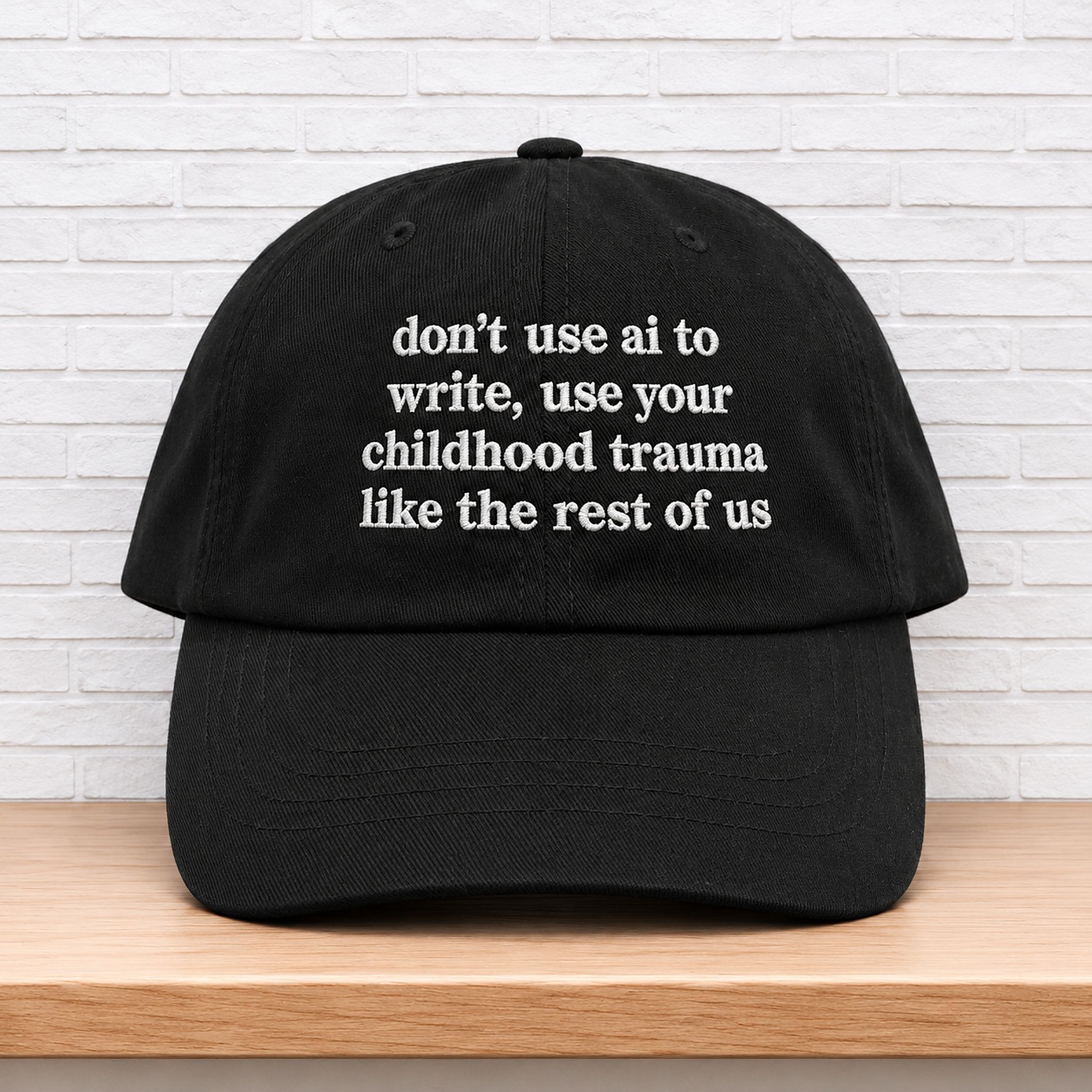
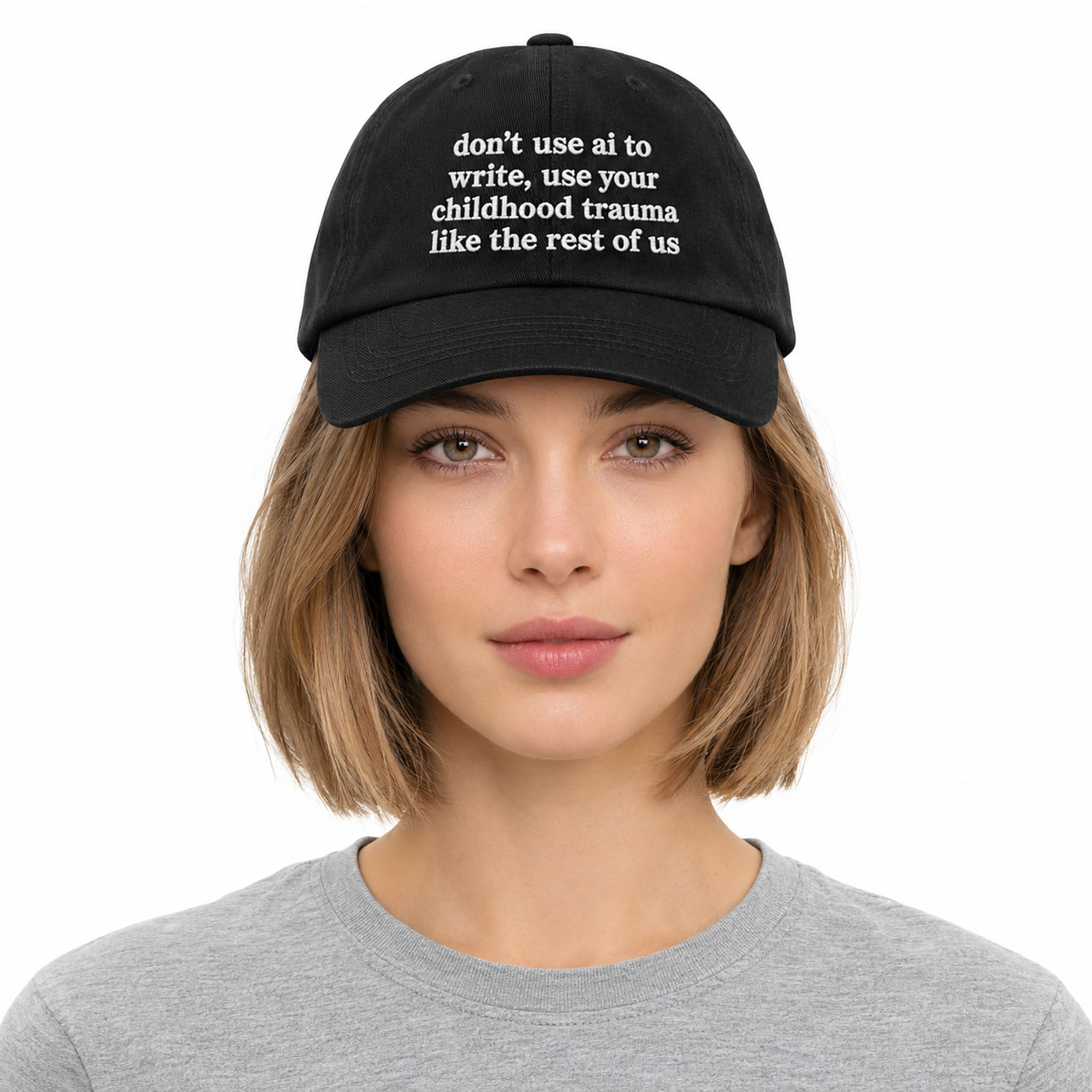
This 2026 Don’t Use AI To Write Use Your Childhood Trauma Like The Rest Of Us Hat features white lowercase serif lettering centered on the front crown, with the slogan stacked in four lines above a plain curved brim. The serif letters have small strokes at their ends, giving the message the look of a sentence lifted from a book. Even “ai” stays lowercase, so the abbreviation reads in the same quiet voice as the rest of the line. The comma after “write” is the only pause within the sentence, and the final line ends without a period.
The line breaks shape how the joke unfolds. The first line stops at “to,” carrying the eye straight into “write” on the second line. That same line starts the pivot with “use your,” then gives “childhood trauma” a line of its own. The last line settles beneath it like an aside, making the instruction sound like something an entire room of writers has already agreed on.
The lettering sits in a compact block at the center of the rounded black crown, below the small black top button. The curved brim carries the black color through the lower half of the front, with subtle rows of stitching following its edge. With no illustration, emblem, or number competing for attention on the front, the contrast between the white words and the black background does the visual work.
The slogan pokes fun at AI-assisted writing by suggesting that writers should mine their own messy memories for material. The joke borrows the voice of someone handing down a rule about creative work, then offers advice that sounds far too personal to put in a writing manual.
The phrase “like the rest of us” is where the speaker gives themselves away. It puts them in the same group as the people they’re teasing and makes the line feel like a confession delivered with a straight face. There’s also a joke about what a writer brings to a sentence. A tool can supply words in response to a prompt, while the person writing gets to decide which memory matters, what detail to keep, and how much to tell. The hat squeezes that distinction into an exaggerated instruction about childhood, then gives its imaginary club of writers the last word.
Product Details
Product Type — Hat
Color — Black with white lettering
Front Design — Four centered lines of lowercase serif text
Brim — Curved black brim with visible stitching
SHIPPING POLICY
WHAT ARE THE SHIPPING COSTS?
Domestic shipping within the United States is set at $5.95 USD. International shipping begins at $13 USDWHERE DO WE SHIP?
We proudly ship worldwide, extending our services to customers across the globe.Shipping time
US Regions:
| Item | Handling time (Mon-Fri) | Shipping time ( Mon-Fri ) |
| Apparel | 1-3 days | 3 -7 days |
| Mug | 2-3 days | 3-7 days |
| Poster, Canvas | 1-3 days | 3 -7 days |
| Hats | 2-3 days | 6-8 days |
| Bedding | 3-5 days | 7-10 days |
| 3D Clothing, Hawaiian shirt… | 3-5 days | 8-12 days |
Other Countries:
Handling time (Mon-Fri): 3-5 days
Shipping time ( Mon-Fri ): 15-25 days.
Note: Delivery times may vary due to holidays, destination, or courier delays.Delivered
Total delivery time = Handling time + Shipping time While we provide estimated delivery timelines, please be aware that unforeseen delays beyond our control may occur. These may include factors such as courier logistics, customs inspections, weather conditions, national holidays, or incomplete delivery details. We recommend allowing additional time when planning deliveries close to specific deadlines. We continuously strives to ensure prompt and secure delivery, yet cannot be held liable for delays caused by third-party or external circumstances. If you experience any issues with your order or need assistance with modifications, please contact us at [email protected]. Our support team is always ready to help and ensure your satisfaction. Regarding shipments with multiple addresses, we regret to inform you that our system currently does not support this feature. Should you wish to send items to separate destinations, please place individual orders for each address. Shipping is available for PO Boxes; however, we do not support delivery to Military APO/FPO addresses at this time. Concerning international orders, please note that all shipments from the United States are processed DDU (Delivered Duty Unpaid). We does not collect VAT or import duties during checkout. Any applicable customs fees, VAT, or import duties are the responsibility of the recipient upon the package’s arrival. We encourage customers to check with their local customs authorities for guidance on applicable duties or tax policies in your region.Quick FAQ
Every Zerelam garment is made-to-order using premium materials carefully selected per product. Most of our apparel is crafted from high-quality polyester, cotton, or polyester-cotton blends, chosen for softness, breathability, and long-term shape retention.
Designs are applied using Direct-to-Garment (DTG) or All-Over Print (AOP) sublimation with OEKO-TEX-certified, water-based inks. This gives sharp colors, a smooth feel, and a print that bonds directly with the fabric — no cracking, peeling, or vinyl-style overlay. The exact fabric and print method for each item is listed in the product description above.
Zerelam offers inclusive sizing on most apparel from XS up to 5XL, so every body can find the right fit. Our tees and hoodies follow a unisex, true-to-size cut with a relaxed shoulder line and a slightly longer back hem for natural movement.
For the best result:
- Check the size chart on the product page — measurements are listed in both inches and cm.
- If you’re between two sizes or prefer an oversized look, size up one.
- AOP (all-over print) styles tend to fit slightly more relaxed than DTG tees.
Still unsure? Email [email protected] with your height, weight and usual size — we’ll recommend the best fit.
To keep your Zerelam apparel looking new and the prints vibrant for years, follow these simple care steps:
- Machine wash cold (max 30°C / 86°F) on a gentle cycle.
- Turn the garment inside out before washing to protect the print.
- Use a mild, bleach-free detergent — skip fabric softeners and harsh chemicals.
- Tumble dry low or hang dry in the shade. Avoid high heat.
- If ironing, iron inside-out on low heat — never directly on the print.
- Do not dry-clean.
Following these guidelines protects the DTG/sublimation print and keeps the fabric soft, structured, and color-rich wash after wash.
Yes — durability is a core part of what we build at Zerelam. Every piece is printed with professional-grade Direct-to-Garment (DTG) or sublimation technology using OEKO-TEX-certified, water-based inks that bond directly with the fabric fibers instead of sitting on top like vinyl or transfers.
When you follow our care guide (cold wash, low-heat dry, inside-out ironing), customers consistently report that prints stay vibrant for 50+ washes with no cracking, peeling or flaking. Our heavyweight cotton blends and reinforced double-stitched seams help the garment itself hold its shape and color long-term.
If you ever receive an item with a printing defect, contact [email protected] within 7 days and we’ll send a free replacement.
Every Zerelam item is printed, finished and shipped from our partner production facilities in the United States, primarily based in Michigan and across our U.S. fulfillment network. Because we operate on a true print-on-demand model, nothing is mass-produced overseas — your item is custom-made after you check out.
Standard production takes 3–5 business days before your order leaves our facility. From there:
- USA: typically 5–8 business days door-to-door.
- International: typically 10–25 business days, depending on destination and customs.
Each package is shipped with a tracking number emailed to you the moment it leaves the warehouse.
 Don't Use AI To Write Use Your Childhood Trauma Like The Rest Of Us Hat
Sorry, no reviews match your current selections