
Sports
Beyond the Heisman: The Viral Story of Iconic Tim Tebow Swamped Shirt

Dec
A Single Piece of Cloth, A Thousand Words of Glory
In the vast and often hyperbolic landscape of college football, where legends are forged in the fires of rivalry and championship rings are the ultimate currency, few items possess the visceral, immediate power of a single, stained piece of cloth. This is the story of that cloth: the jersey famously dubbed the “Tim Tebow Swamped Shirt.”
More than just a piece of Florida Gators uniform, this jersey—splattered with red paint from the University of Phoenix Stadium field—became an enduring symbol of grit, determination, and the triumphant, almost spiritual, intensity of Tim Tebow‘s college career. It is a relic of the moment the Gators, led by a dynamic sophomore quarterback, utterly dominated the Ohio State Buckeyes to claim the 2007 BCS National Championship.
The Setting: Glory in the Desert
The year was 2007 (following the 2006 regular season). The location was Glendale, Arizona. The Florida Gators, under the ambitious and demanding leadership of Head Coach Urban Meyer, had clawed their way to the BCS National Championship game. Their opponent: the highly favored, undefeated Ohio State Buckeyes, led by Heisman Trophy-winning quarterback Troy Smith.
The narrative leading up to the game was set: A high-flying, traditional Big Ten powerhouse against the SEC’s dark horse, a team that many analysts believed didn’t even belong in the game. It was a classic David vs. Goliath scenario, but this time, David had a secret weapon—a ferocious, physically imposing, and intensely passionate quarterback named Tim Tebow.
Tebow was only a true sophomore, but his presence was already seismic. He wasn’t merely a player; he was the spirit of the team, embodying the relentless, ‘never-say-die’ attitude that Urban Meyer preached. The Championship Game was his stage, and what followed was not a competitive contest, but a complete, systematic swamping of the Buckeyes.
The Game Itself: A Dominant Performance
The Gators were magnificent. They shut down the Buckeyes’ vaunted offense, holding Troy Smith and the high-powered attack to a mere 14 points. On the offensive side, Tebow and the Gators’ innovative spread-option offense ran riot. Tebow showcased his dual-threat capability, passing for 154 yards and running for another 65, including a crucial rushing touchdown.
The final score was a stunning 41-14 victory for the Florida Gators. It was a demolition that shocked the college football world and cemented the SEC’s rising dominance.
The Birth of the Icon: The Swamped Shirt
Amidst the jubilant chaos of the final moments and the post-game celebration, the true iconic image was captured—one that had nothing to do with statistics or trophies, but everything to do with raw effort.
As Tim Tebow celebrated the victory, his #15 jersey was visibly and dramatically stained. The white fabric was splashed with streaks of bright red—the result of the artificial turf paint used on the field, which had leached onto his uniform through sweat, dirt, and repeated, violent impact with the ground. His jersey wasn’t just dirty; it looked as if he had literally bled red and blue for his team.
More Than a Stain: The Symbolism
- The red stain was a powerful visual metaphor for the entire game and Tebow’s playing style:
- Maximum Effort: The stain showed that Tebow hadn’t just stood back and thrown the ball; he had been in the trenches, taking hits, driving his knees into the turf, and fighting for every yard. It was a badge of honor testifying to his bruising, physical style of play.
- The “Swamp” Mentality: While the game was played in a dry desert environment, the stained jersey evoked the gritty, humid, and rough-and-tumble environment of Florida football—the “Swamp.” The image suggested that Tebow had dragged the mighty Buckeyes into the mud and emerged victorious, caked in the residue of the battle.
- The Anti-Glamour: In an era increasingly focused on commercialism and polish, the ruined jersey was a refreshing, authentic image. It said that for Tebow, the appearance didn’t matter; the win and the effort were everything.
Corey Bender’s Immortalization
The connection you cited in the prompt, referring to Corey Bender, is crucial here. Moments like this often need a great photo or a definitive statement to become immortal. The image of the “Swamped Shirt,” often shared by journalists and commentators like Bender, served as a powerful visual anchor for the victory. It wasn’t just a win; it was a statement—one delivered with brute force and represented by a permanently marred uniform. The image became a rallying cry and an instant classic, capturing the zeitgeist of that Gators championship team.
The Enduring Legacy of the Swamped Shirt
The “Swamped Shirt” transcends mere memorabilia; it is a piece of college football canon. Its legacy is multifaceted, influencing everything from sports marketing to the perception of Tim Tebow himself.
A Symbol of the Tebow Era
Tebow’s career at Florida (2006-2009) was legendary: two National Championships, a Heisman Trophy, and an unprecedented level of national attention. The Swamped Shirt moment, coming in his sophomore season, perfectly prefigured the intensity of his junior and senior years. It established the standard: Tebow gives everything.
The jersey became a shorthand for his entire brand: physicality, piety, and relentless competitive drive. When fans recall Tebow’s college days, the memory is often of him scrambling, praying on the sideline, or, most vividly, standing victorious in that red-splattered jersey.
Influence on Fan Culture and Merchandising
The symbolic power of the jersey was immediately recognized by fans and entrepreneurs. While the original jersey remains a historical artifact, its image quickly inspired countless pieces of fan merchandise:
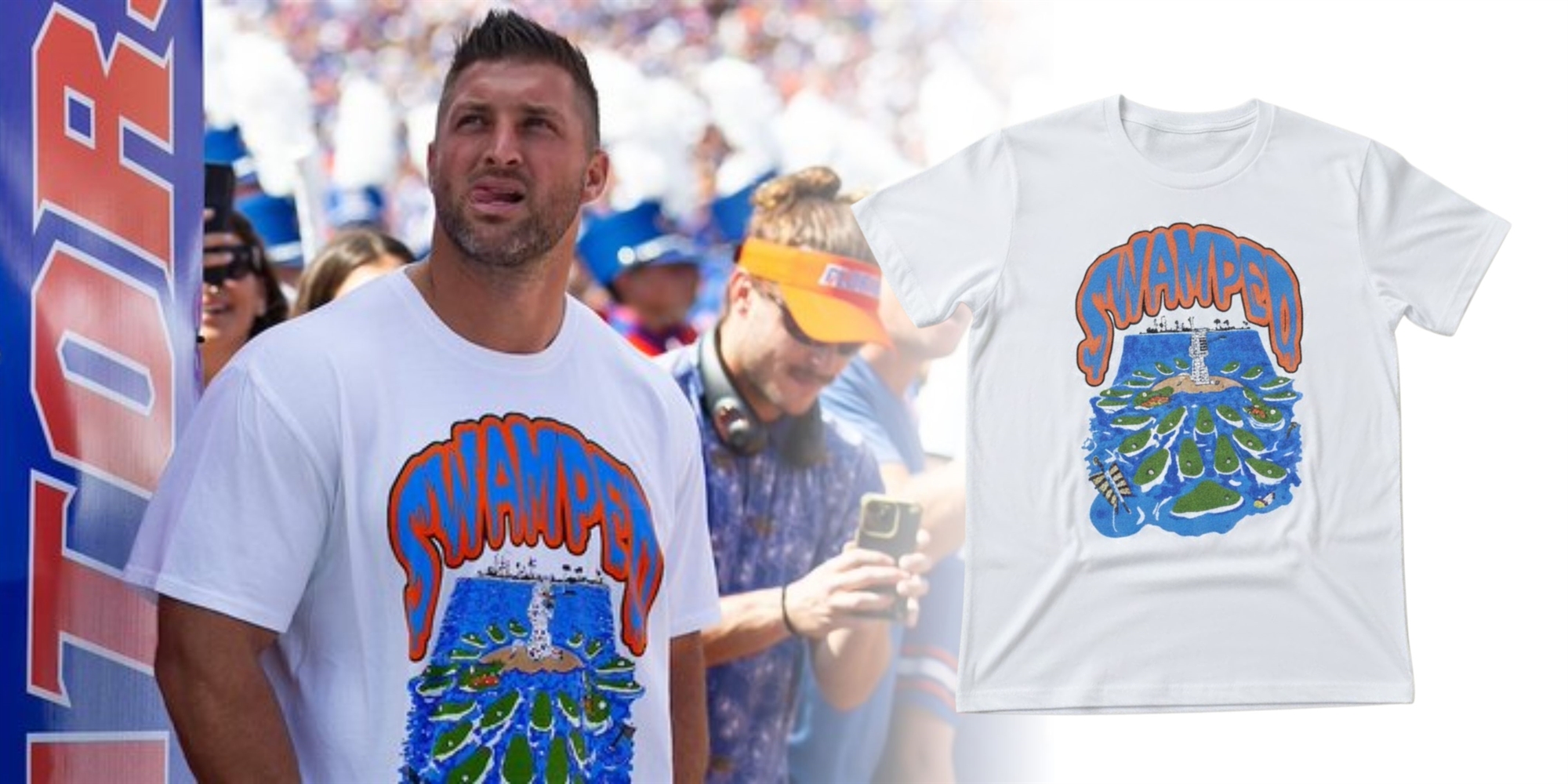
- Tribute T-Shirts: The most common homage is the reproduction of the image on T-shirts, often featuring the Gator logo, the year 2007, and the iconic stained number 15. These shirts are not merely commemorating a championship; they are celebrating the effort embodied by the shirt itself.
- Artwork and Prints: The image has been immortalized in prints, posters, and paintings, often with dramatic lighting to emphasize the contrast between the white uniform and the red stain. These artworks are collectors’ items, representing a high point in Florida Gators history.
- A “Meme” Before Memes: In the early days of social media, the image spread rapidly, becoming one of the first truly viral pieces of sports imagery. It was a visual punchline for Florida’s dominance and a symbol of their intensity.
The Contrast with Modern Football
The story of the Shirt takes on added resonance in the modern era of Name, Image, and Likeness (NIL) and hyper-polished athletes. The red stain serves as a powerful reminder of a slightly simpler time, one where the focus seemed less on personal brand development and more on the visceral, painful, and often ugly effort required to win a title.
Tebow’s jersey was the opposite of pristine. It was damaged, and that damage made it more valuable, more authentic, and more beloved by the fan base. It was a tangible piece of the sacrifices made on the field.
Conclusion: The Stain That Never Fades
The “Tim Tebow Swamped Shirt” is a rare piece of sports history—an object whose significance far outweighs its material value. It is not famous for being expensive or luxurious, but for being destroyed in the act of achieving greatness.
It encapsulates the defining characteristics of a legendary player and a championship team: relentless effort, physical dominance, and the sheer will to win. The red stain on the white fabric of the #15 jersey tells a complete story in a single frame: the story of an underdog rising to supremacy, of a team that outworked and overpowered its opponent, and of a quarterback who left literally everything, including the paint from the turf, on the field.
For Florida Gators fans, the sight of the “Swamped Shirt” is an instant transport back to that glorious night in Arizona—a reminder that sometimes, the true beauty of sport lies not in perfection, but in the rugged, visible evidence of the battle fought and won. The stain may have been red, but the victory was pure Gator Blue and Orange, and its legacy remains indelible.
